

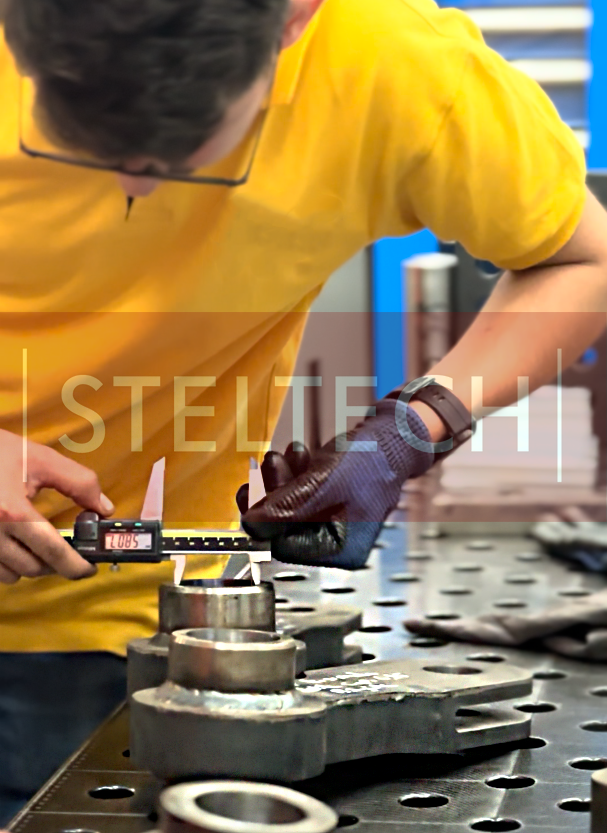
Strength You Can Measure
In steel manufacturing, quality isn’t assumed — it’s proven.
Every beam, sheet, and rebar that leaves a mill carries a silent guarantee: that it has passed a rigorous series of strength and durability tests.
At Steltech Makina, we understand that trust in steel begins in the laboratory.
Our testing processes transform molten metal into certified strength — ensuring every product meets international standards before it ever reaches the construction site.
The Science Behind Strength
Steel’s true potential lies in its ability to endure stress, tension, and time.
To verify that performance, engineers conduct an array of mechanical and metallurgical tests, each designed to measure a specific property.
The key tests include:
-
⚙️ Tensile Test: Determines yield strength, elongation, and ultimate tensile capacity.
-
🧱 Bend and Re-bend Test: Confirms ductility and resistance to cracking under stress.
-
💥 Impact Test (Charpy V-Notch): Evaluates how steel performs under sudden shock or load.
-
🔬 Microstructure Analysis: Examines grain size and composition for internal consistency.
-
🌡️ Hardness and Fatigue Tests: Gauge long-term durability under continuous use.
Each test tells a story — not just of metal, but of reliability.
Why Testing Matters
A single weak batch can compromise an entire structure.
That’s why every Steltech steel product undergoes multi-phase verification before certification.
Through our testing partners and in-house QA laboratories, we ensure:
-
Consistency across mechanical and chemical properties.
-
Compliance with DIN, EN, and ASTM global standards.
-
Full traceability — from heat number to final inspection.
By integrating testing into every production stage, we don’t just meet standards — we define them.
Technology That Strengthens Trust
Modern testing goes beyond manual inspection.
At Steltech Makina, we leverage digital test benches, laser extensometers, and data logging systems to monitor each result in real time.
Our quality teams use advanced software to track performance trends and identify micro-anomalies long before they become risks.
The outcome? Steel that isn’t just strong — it’s predictably strong, batch after batch.